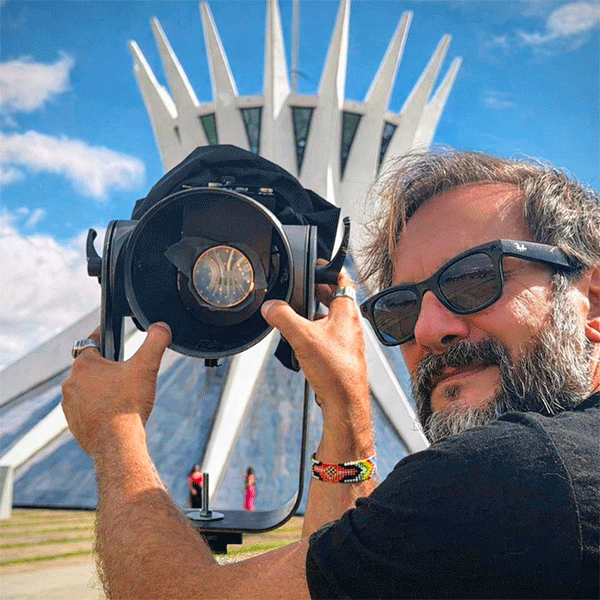
Biography
Pioneer of architectural lighting
An Italian-French artist, pioneer of a luminous art that reconciles technology with heritage.
THE ARTIST
Gaspare Di Caro is a Franco-Italian artist and luminographer whose work transforms light into a language and architecture into a medium.
His career began in cinema, where he notably worked alongside Ettore Scola, before moving through literature, theatre and the visual arts.
Along the way, he encountered major figures of literature and thought such as Italo Calvino, Alberto Moravia and Eugène Ionesco, whose influence profoundly shaped his relationship with narrative, space and perception.
From these successive experiences—from cinema to literature, from theatre to luminography—emerged an artistic language in which the image is constructed within real space. He thus developed luminography, literally “writing with light”, at the crossroads of art, optics, architecture and memory.
Building on the Renaissance exploration of the camera obscura and perspective, he transposes these principles into contemporary architectural space.
Each work is born from a specific place and a carefully determined viewpoint, which he calls the Œil du Prince — the Prince’s Eye.
From this unique vantage point, drawing, light and architecture are recomposed, turning the monument itself into the medium of the artwork.
Technology, although essential, is ultimately intended to disappear: when the artwork appears, nothing should remain but the light.
This research has led him to create works on iconic architectural sites and monuments throughout Europe and Latin America.
From Christ the Redeemer in Rio de Janeiro to Oscar Niemeyer’s National Museum in Brasília, his works confront light with monumental scale.
In Cuba, his luminographies have transformed major buildings in Havana and Santiago de Cuba; in Ragusa Ibla, light brings the memory of the 1693 earthquake back to life.
Permanent, precise and highly energy-efficient, his luminography proposes a different approach to monumental lighting: to reveal rather than simply illuminate.
Gaspare Di Caro thus creates monumentality without mass, capable of transforming architecture without ever touching it.
From narrative to image, from image to space: architecture becomes the canvas, light becomes the writing, and the Prince’s Eye becomes the artwork.
THE TECHNIQUE
Luminography makes it possible to project images that are carefully calculated and drawn in perspective using the Camera Obscura, a tool used by the great masters of the Renaissance. Measurements of distance, perspective angles, vanishing lines, as well as axes and parallaxes, are inspired by the calculations of Filippo Brunelleschi.
It ensures highly precise projection, long-lasting installations, no light pollution, and low energy consumption relative to the illuminated surface. Although rooted in ancient principles, this technique is firmly oriented toward the future.
Background
Key milestones
Christ the Redeemer, Rio de Janeiro
First illumination of the Christ the Redeemer statue. Luminography revealed the statue’s face for the first time.
Havana Cathedral
Luminographic intervention during the visit of Pope Benedict XVI.
Trevi Fountain, Rome
Luminographic intervention on one of the world’s most iconic monuments. A lighting design conceived as a revelation, respectful of the work and its history.
Palacio de Cibeles, Madrid
Architectural lighting of a major building, revealing its lines and identity through a precise luminous language.
Cathedral of Our Lady of the Assumption, Santiago de Cuba
Intervention on a place of universal pilgrimage. Light becomes a silent language, serving the sacred.
Collioure, France
Creation of the largest luminography in the world. In Collioure, birthplace of Fauvism, light becomes lumism.
Le Provençal, Juan-les-Pins
Permanent luminographic signature on an iconic façade of the French Riviera.
Cannes, Nice, Taghazout
Adopt the luminographic process through permanent installations. A new approach to urban lighting, becoming a lasting signature for cities.
Palácio do Rio Branco, Salvador de Bahia
Lighting of a historic building, revealing its presence within the Brazilian urban landscape.
Oscar Niemeyer Museum, Brasília
Intervention on an iconic modernist architecture, where light enhances the form without constraining it.
Architectural and institutional projects
Development of an architectural focus in collaboration with developers and public authorities. Luminographic installations designed as lasting signatures.