White House Luminography Project

As the 250th anniversary of the United States approaches, the White House becomes a point of convergence between memory and projection.
This proposal does not aim to transform the architecture, but to reveal it. Through a luminographic process, light follows the lines, respects the openings, and contours the windows — it never imposes itself, it accompanies.
The envisioned installation is designed to last: a large-scale lighting concept with low energy consumption, no light pollution, conceived as a continuous presence rather than a temporary event.
Colors, rhythms, and intensities evolve subtly, like a breathing motion. A powerful and impactful light signature, worthy of a global symbol.
Here, light does not cover history. It allows it to emerge.
- Large-scale installation
- Low energy consumption
- No light pollution
- Full respect of architectural openings
- Continuous presence, not event-based
- Subtle evolution of colors and intensities
Los Angeles 2028 City Hall Luminographic System
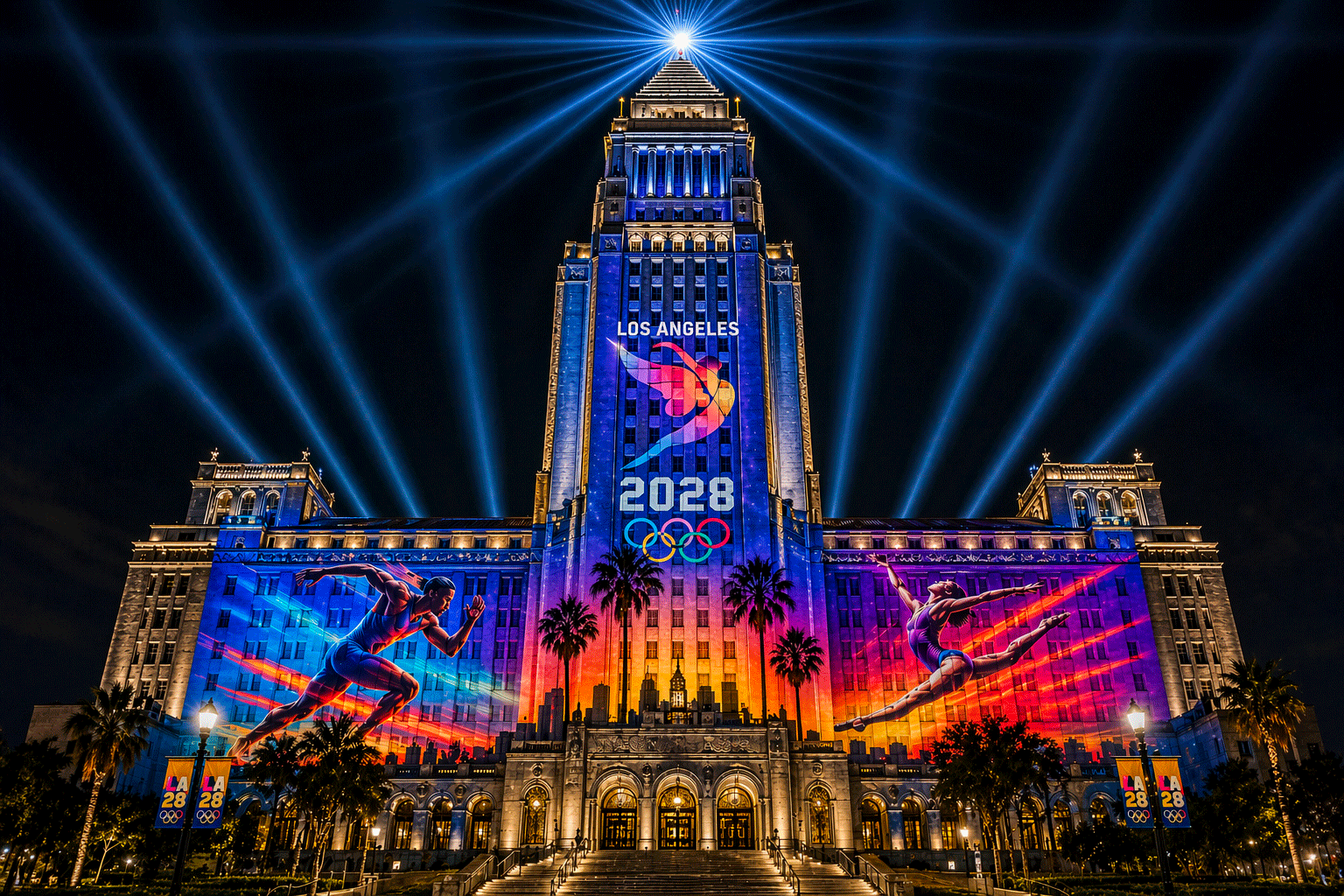
This project proposes the illumination of Los Angeles City Hall as part of the 2028 Olympic Games, using a luminographic process designed for complex architectures.
Luminography enables large-scale projection without the use of screens or traditional video mapping. The system relies on precise optical work (gobos, long focal lengths, anamorphic adjustments) to perfectly follow the building’s lines.
The system allows the evolution of light content (colors, rhythms, intensities) without modifying the main infrastructure. The goal is to transform the façade into a distinctive luminous medium, readable from a great distance, while preserving the architectural integrity of the building.
- No projection into windows — full respect of openings
- Very low energy consumption compared to video solutions
- No light pollution — controlled and directed light flow
- Long-term installation designed for continuous operation
- Reduced maintenance with robust and calibrated equipment
- Content evolution without modifying the infrastructure